












How to Teach Child to Read at Home in a Hindi English Household


In Neha’s home, the morning sounds like this. Her mother-in-law calls out “jaldi karo, bus aa jayegi”. Her husband asks in English where his charger is. Her four year old answers both in a mix of the two, with a Hindi verb and an English noun in the same sentence. Then she opens his school diary and sees a note asking parents to practise English reading at home. Where does she even start? Like many parents, she types “teach child to read at home” into her phone that night.
If this sounds like your house, you are in good company. Most Indian families trying this are doing it in a mixed-language setting. That is not a disadvantage. With a little planning, it can be a strength.
Your mixed home is not a problem
Some parents worry that speaking Hindi at home will slow down English reading. In most cases, it does not. A child who hears rich language at home, in any language, builds vocabulary, listening skills and an understanding of how stories work. All of that carries over.
What a child does need is clear, separate exposure to English sounds and words when it is time to read in English. Mixing is fine for conversation. For reading, the sounds need to be crisp and consistent.
So keep talking the way you talk. Just add a short, focused English reading time to the day.
Start with sounds, not the alphabet song
The alphabet song is charming, but it teaches letter names. Reading needs letter sounds. The letter m says mmm, not “em”. The letter t is a quick tap, not “tee”.
Begin with a few sounds at a time. Say each one clearly, without an extra “uh” on the end. Point to the letter as you say it. Ask your child to copy. A few minutes a day is plenty.
If your child already reads a little Hindi, use it. Devanagari is taught by sound, so the idea that a letter stands for a sound is already familiar. You can say, “Just like म gives the m sound, this English letter m gives the same sound.” That bridge helps many children.
A simple daily plan to teach child to read at home
Pick one fixed time. For many families it is after the evening snack. For others it is just before bed. Consistency matters more than the hour you choose.
Spend the first few minutes on sounds, the next few on blending sounds into short words like sat, pin and hop, and the last few reading something together. A picture book, a label on a packet, a short line you wrote on a slate. Fifteen minutes in total is enough for a young child.
Stop before your child gets tired. Ending on a happy note is what makes tomorrow easy.
Get the whole family on the same page
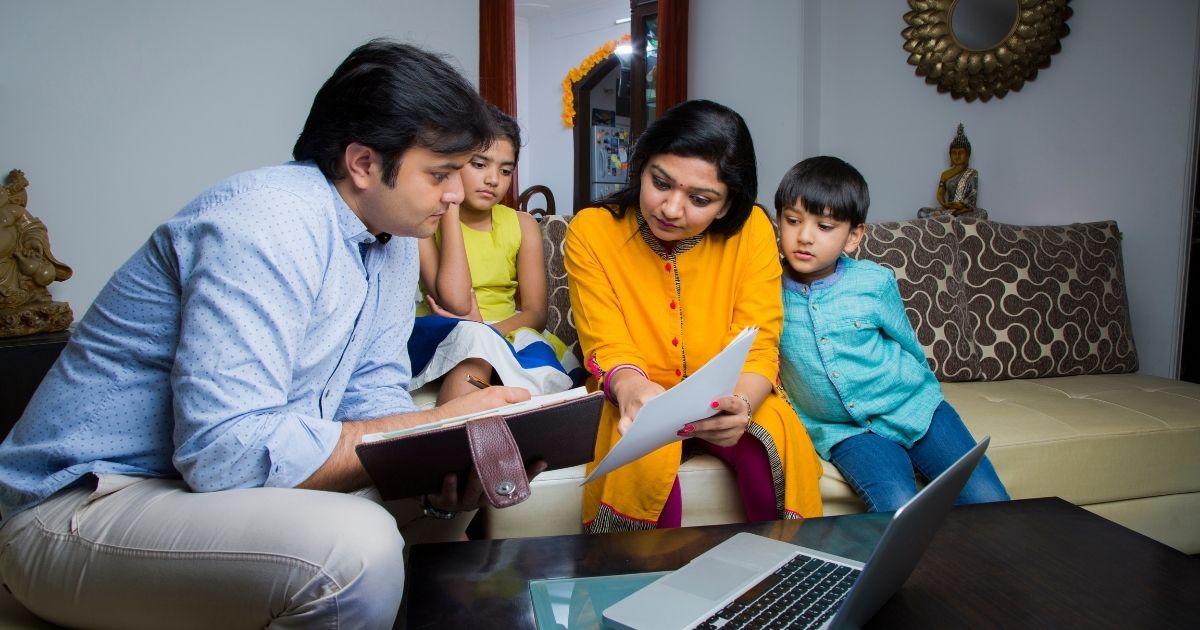
In a joint family, a child might hear phonics from you, “A for Apple” from dadi, a different pronunciation from a tuition teacher and another from a cousin. That is a lot of noise.
Have a quick chat with the people your child spends time with. You do not need to give a lecture. Just say, “We are teaching him the sounds of letters now, not the names. M says mmm.” Most grandparents are happy to help once they know what you are doing, and some love taking over the bedtime reading.
Fathers can play a big part here too. Reading English signboards together on a weekend drive or reading the cricket score from the newspaper counts as practice.
Make English reading part of everyday life
Reading in English at home does not have to come only from schoolbooks. Use what is already around you.
Read the names of brands on biscuit packets and soap wrappers. Read the English words on the auto in front of you. Write a short grocery list in English and let your child read one item. Stick labels like door, fan and bed around the house for a week.
These tiny moments, five seconds each, add up to a child who sees English print as something useful, not just homework.
Speak clearly, even if your own English is not perfect
Many mothers hesitate to teach English reading because they feel their own English is weak. Please do not let that stop you. Your child does not need a perfect accent from you. They need clear sounds and lots of patience.
If you feel unsure, learn the phonics sounds yourself first. It takes a few weeks of focused effort and makes every later step easier. Early reading for kids goes much smoother when the parent beside them knows exactly what each letter says. Hindi-speaking mothers often find it easier to learn this in Hinglish, where the explanation comes in the language they think in.
Also read
Start learning with Honey Maheshwari
The Live Phonics Course for mothers and teachers is taught in Hinglish, mostly Hindi with some English, over two weeks. The Recorded Phonics Course for Mothers lets you learn at your own pace with one year of access. For your child, A Strong Foundation for Reading and Speaking Skills is a recorded day-wise course. Call +91 86795 44344, email ma**@*************ri.in, or see the courses on honeymaheshwari.in.

livelihoodparenting

