







Blending Sounds for Kids Who Know Letters but Cannot Read Words

Your child knows every letter. They can tell you that m says mmm and t says a short t. They can even point to the letters on a toothpaste tube. So why, when you write “mat” on a page, do they say the three sounds perfectly and then look up at you with no idea what the word is? If this is your evening, blending sounds for kids is the piece that is missing.
This is one of the most common worries parents bring to phonics, and the answer is almost always the same. Your child has learnt the sounds, but not yet how to join them. Joining sounds is a separate skill, and it needs to be taught on purpose. The good news is that it usually comes with a few weeks of the right kind of practice.
Why knowing letters is not the same as reading
Think of letter sounds as beads and a word as a necklace. Knowing all the beads does not mean you know how to string them. A child who says “m… a… t” with long pauses has three separate beads in their head. They need to hold the first sound in memory while hearing the second, then the third, and then hear all three as one word. That is a lot of work for a young brain, especially if the sounds have extra bits stuck to them.
That extra bit is the first thing to check. Many adults teach sounds with an “uh” at the end. “Muh”, “tuh”, “buh”. If your child says “muh-a-tuh”, the word that comes out sounds nothing like mat. Clean, short sounds make blending far easier. Hold the sounds that can be stretched, like m, s, f and n, and keep the stop sounds, like t, p and b, quick and crisp.
The other common gap is the ear. Some children cannot yet blend sounds they hear, let alone sounds they read. That is where oral blending comes in.
Start with the ear before the eye
Oral blending means blending sounds without any letters at all. You say the sounds, your child says the word. It removes the job of looking and remembering letter shapes, so your child can focus only on joining.
Make it a game during everyday moments. At the dining table, say “Pass me the r-o-t-i,” saying the sounds of roti slowly, and see if your child hands it over. In the bathroom, “Where is your t-oo-th-b-r-u-sh?” may be too long at first, so start with short ones like “Touch your n-o-se” or “Find the c-u-p.” Hindi words work too for warming up the skill. “Bring the k-e-l-a.” The goal is to train the ear to hear separate sounds as a whole.
Once your child can do this easily with three-sound words, they are ready to blend with letters in front of them.
Segmenting is the same game in reverse. Say a word, and let your child break it into sounds. Cup becomes c-u-p. Children who can do both directions usually find that reading and spelling start to support each other.
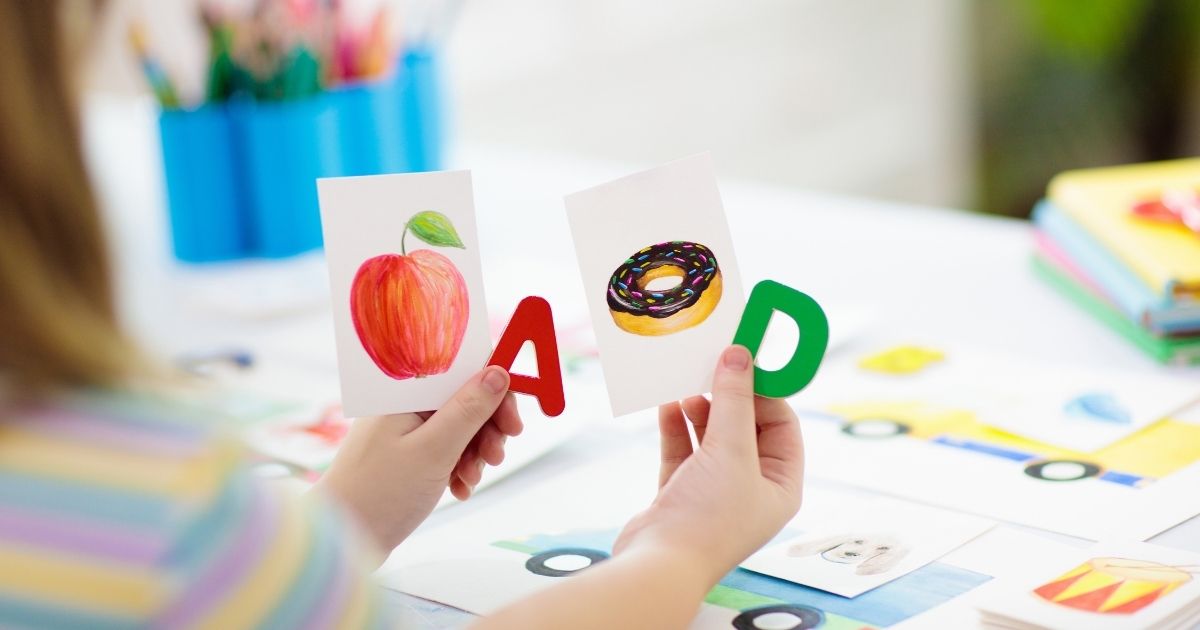
Blending sounds for kids with letters, step by step
Start with continuous sounds. Words that begin with m, s, f, n or l are easiest because you can stretch the first sound into the vowel without a break. “Mmmaaat” is much easier to hear than “t… a… p.”
Use your finger. Slide it slowly under the word from left to right, and say each sound as your finger reaches it, without stopping between them. Then slide faster. Then say the word.
Try blending the first two sounds before adding the last. For “sat”, say “sa” first, then add t. Some children find this much easier than holding three loose sounds.
Keep words very short and very familiar for a while. Mat, sat, man, fan, sun, fun. Do not move to four-letter words until three-letter ones feel easy.
Repeat the same few words across days. Reading the word “sun” on Monday, Tuesday and Wednesday is not boring to a child who is still working hard to blend it. It is building the path in the brain.
Keep a small list of the words your child has blended on their own and read it back to them at the end of the week. Seeing that list grow tells them they are a reader, and it tells you which sounds still need work.
Celebrate the attempt, not only the right answer. If your child blends “s-u-n” into “son”, say “So close, listen again, s-u-n,” and let them try. A child who feels safe making mistakes will keep trying.
Some children get blending in a week. Others take a couple of months. Neither is a sign of anything worrying on its own. If your child is over six and still cannot blend after steady, patient practice, it is worth speaking to their teacher, but for most children the skill arrives when the conditions are right.

Also read
Start learning with Honey Maheshwari
If you want a structured path for blending sounds and early reading, A Strong Foundation for Reading and Speaking Skills is a day-wise recorded course for kids. Parents who want to learn the method can join the Live Phonics Course or the Recorded Phonics Course for Mothers. Call +91 86795 44344, email ma**@*************ri.in, or reach out through the Contact page on honeymaheshwari.in.

livelihoodparenting