









Reading Readiness Signs in 3 to 5 Year Olds Every Parent Can Spot


Is my child ready to read? Almost every parent of a three or four year old asks this at some point, usually after hearing that a neighbour’s child is already reading small words. The question is fair, but the answer is rarely found in a test or an age. It is found in small behaviours you can see at home, often while you are doing something else. These reading readiness signs tell you far more than a birthday does.
Children between three and five develop at very different speeds. One may rhyme fluently at three and not care about letters until five. Another may know every letter early but have little interest in books. Both are normal. What follows is not a checklist to pass, just a set of clues to notice.
Listening and playing with sounds
The earliest reading readiness signs are about the ear, not the eye. Before a child can read, they need to hear that words are made of smaller sounds.
Watch for rhyming. Does your child notice that cat and hat sound alike? Do they make up silly rhymes, like “mango, tango, bango”? That playfulness with sound is a strong sign.
Watch for first sounds too. If your child says, “Mumma, mango and milk start the same,” they are hearing the m sound on its own. That is exactly what phonics builds on.
Clapping syllables in a name, enjoying tongue twisters, and repeating songs with lots of rhyme all point the same way. If you do not see these yet, you can encourage them. Sing rhymes in Hindi and English. Play “I spy something that starts with b.” These games are pre reading skills in their own right.
Interest in books and print
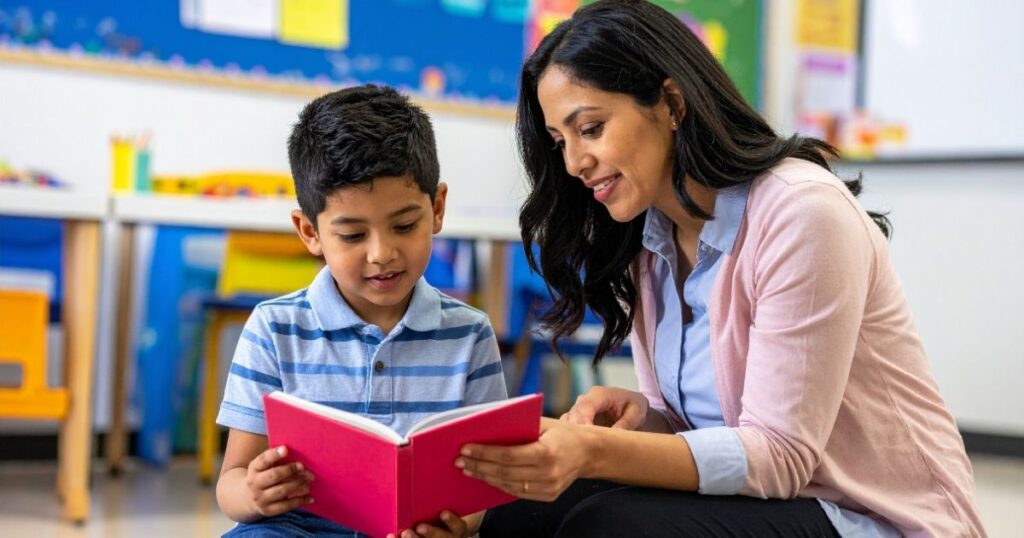
A child who is getting ready to read usually shows interest in print. They point to writing on a cereal box and ask what it says. They pretend to read a picture book, turning pages and telling the story in their own words. They know that a book is held a certain way and that you read from the front.
Pretend reading is worth celebrating. When your child sits with a book and “reads” it to a soft toy or a younger cousin, they are practising how stories flow, how pages turn and how a reader sounds. Do not correct them. Just enjoy it.
Notice whether your child can recognise their own name in writing, or a few familiar logos and signs. Recognising the shape of their name on a tiffin box label is an early step toward understanding that letters carry meaning. Ask your child to find the first letter of their name on a shop board or a number plate, and you will quickly see how much they already notice.

Attention, memory and following simple instructions
Reading asks a child to sit for a few minutes, focus on something small and remember what they just heard. You can see the beginnings of these skills in daily life.
Can your child listen to a short story to the end? Can they follow a two-step instruction like “put your shoes in the rack and bring your water bottle”? Can they retell a simple story, even in a jumbled order? Can they sort things by colour or shape?
Hand skills play a small part too. Holding a crayon, turning one page at a time and stringing beads all build the control that later helps with writing letters, and writing and reading tend to grow together.
None of these are about letters, but they all support early literacy at home. A child who cannot yet sit for five minutes is not failing. They may simply need more time and more playful practice with listening.
What to do when you see reading readiness signs
If you notice several of these reading readiness signs, it is a good time to start gently with letter sounds. Not names, sounds. Begin with a few, keep sessions very short, and make them fun. Five minutes of sound games a day is plenty for a three or four year old.
If you see only a few signs, do not worry and do not push. Keep reading aloud every day, keep singing rhymes, keep pointing out words around you. Readiness grows from this kind of everyday exposure. Pushing formal reading too early often makes children associate books with pressure, which is the last thing you want.
And if your child is five and you see almost none of these signs, have a calm conversation with their teacher. Most of the time there is nothing to worry about, but a teacher who sees your child daily can give useful perspective.

Also read
Start learning with Honey Maheshwari
When your child shows readiness, A Strong Foundation for Reading and Speaking Skills is a recorded, day-wise course for kids that you can play on a phone or laptop. If you want to learn how to guide those first steps yourself, the Recorded Phonics Course for Mothers is a good place to start. Honey Maheshwari also offers parenting guidance for families unsure where to begin. Call +91 86795 44344, email ma**@*************ri.in, or reach out through the Contact page on honeymaheshwari.in.
livelihoodparenting

