









Phonics Training for Teachers in Indian Classrooms

Most teachers in India were never taught how to teach reading. They were taught English, or grammar, or literature, and then handed a class of six year olds and a textbook. The children learnt to read anyway, mostly by memorising, and the ones who could not memorise quickly fell behind quietly. Phonics training for teachers exists to change that pattern, and it fits Indian classrooms better than many people expect.
The rote habit and why it breaks down
Walk past a primary classroom in almost any Indian town and you may hear the chant. “A for apple, B for ball, C for cat.” It is cheerful and it builds familiarity with letter names. It does not teach reading.
A child who has memorised “cat” as a shape can read cat. Show them “cap” and they guess. Show them “cot” and they guess again. By the time the textbook moves to longer words, the guessing stops working, and the child either becomes very good at memorising or starts to dread the reading period.
Phonics gives children a tool instead of a list. Once they know the sounds and how to blend them, every new word is a puzzle they can solve. Teachers who see this in their own class rarely go back.
What phonics training for teachers should cover
Good training starts with the teacher’s own ear. Many adults, especially those who grew up speaking Hindi, Marathi, Bengali or another Indian language at home, were never taught to hear the difference between short English vowel sounds. The a in bat and the e in bet can sound almost the same to an untrained ear. A teacher has to hear these clearly before she can model them.
From there, training moves through the sounds of single letters, how to say them without an added “uh”, how to blend sounds into words, and how to break words back into sounds for spelling. Then come letter teams like sh, ch and th, and the rules that explain common patterns, such as the silent e at the end of words like cake and bike.
Just as important is the classroom side. How to correct a child without embarrassing them. How to spot which children are guessing. How to keep practice short and frequent rather than long and rare.
Making it work with large classes
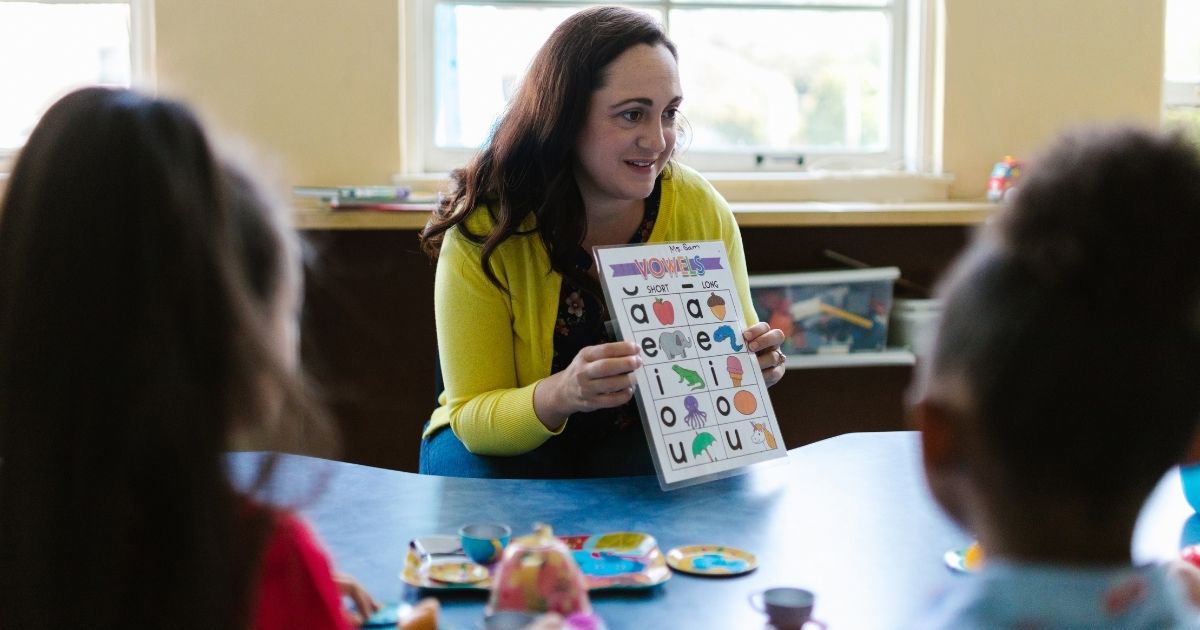
A common worry is that phonics needs one-on-one attention, and Indian classrooms do not have that luxury. In practice, a lot of phonics works beautifully as a whole class.
Sound practice can be done together. The teacher says a sound, the class repeats it, and she listens for the children who are off. Blending can be a group game, with the teacher holding up three letter cards and the class calling out the word. Quick checks can be done with mini whiteboards or slates, which many schools already have, so the teacher can scan thirty answers in a few seconds.
Seating can help too. Pairing a confident reader with one who is still unsure, for two minutes of reading to each other, gives every child practice without the teacher needing to stand at each desk. She walks around and listens, noting which sounds are causing trouble so they go into the next day’s warm-up.
Short daily slots work better than one long weekly period. Ten minutes at the start of each English class keeps sounds fresh and does not eat into the syllabus.
Bringing parents along
Teachers often say the hardest part is home. A child learns the sound of b correctly in class and goes home to a well-meaning parent who says “B for ball” every night. Small notes to parents help, or a short orientation at the start of the year explaining what phonics is and why the school is using it. A simple sound chart sent home, with the sounds written the way the class says them, saves a lot of confusion.
This is also where training for mothers and training for teachers meet. When both the classroom and the home use the same sounds and the same words, children move faster and with less confusion.

Choosing the right phonics teacher course
Look for training that is practical rather than theoretical. You want to leave with things you can do in class tomorrow, not only an understanding of why phonics works. Language matters too. Training in a language you are fully comfortable with lets you focus on the content instead of translating in your head.
Honey Maheshwari’s Live Phonics Course is open to teachers as well as mothers. It runs live for two weeks in Hinglish, mostly Hindi with some English, which many teachers in Hindi-speaking regions find easier to absorb. For teachers who cannot commit to fixed timings, the Recorded Phonics Course for Mothers is also open to teachers and gives one year of access to learn at their own pace.
Also read
Start learning with Honey Maheshwari
Teachers and tutors who want structured phonics training can join the Live Phonics Course or begin with the recorded course. The Phonics Rule eBook and the 100 Printable Worksheets PDF are handy for classroom use as well. Call +91 86795 44344, email ma**@*************ri.in, or see the courses on honeymaheshwari.in for details.

livelihoodparenting